
Your Guide to Video Production and Editing Terminology
Compelling content is key for businesses to stand out and connect with audiences. At AVC, we’re in an exciting growth phase as more businesses recognise the value of professional content production and how effective video production and editing services can enhance their businesses.
Recent predictions indicate that 88% of people want to see more video content from brands.
Many of the brands we work with are intimidated by video production. It’s a multifaceted, technical process, often complex, and perceived as very expensive. This blog aims to explain the basics of video production and editing, breaking down key terms and concepts. By the end, you’ll have a clearer understanding of the wonderfully daunting world of video production and editing. If you’re still unsure, we host tailored workshops for businesses of all sizes.
Let’s begin
Video production essentially revolves around three vital stages: Pre-production, Production, and Post-production. But what does this mean, and what does each phase entail?
What Is Pre-Production for Video?
This initial phase lays the groundwork for your video project. At AVC, we’re not just creative but strategic. This means we consider how each piece of content fits in with your wider digital marketing and business strategies.
Pre-Production varies on the length and technical complexity of your video, but usually begins with a kick-off call to determine the following:
- Purpose
- Target audience
- Goals
- Concept development – is this an event, a documentary, interview, a panel discussion, a show reel, or a scripted advert?
- Tone
- Budget allocation
- Location
- B-roll/storytelling
- Define who is going to be recorded.
- Are any specialisms required to assemble the crew, such as drone footage or advanced animation?
- Consider necessary permits, e.g. model release forms.
Once everything is agreed upon, we send clients a briefing pack with everything they need to prepare, from logistics to key questions we’ll ask during filming.
Key Terms During Pre-Production Include:
Scriptwriting: A written document that outlines the dialogue, actions, and directions for each scene. When working with businesses this is included in their briefing packs and rather than a full script it is likely to cover key topics, questions and a vague direction of conversation.
Storyboarding: This falls under creative direction. We’ll provide examples of shots, locations, and angles which can be from our portfolio of work or third-party examples such as music videos, films, or stock footage.
Location scouting: The process of identifying and securing optimal filming locations. This could be an owned location such as your office or home, or it might be that we need to rent a space for the day. For Series 1 of Cyber Made Human, we spent a long time deciding what aesthetic we wanted to convey. We opted for a relaxed, simple, comfortable space and settled on a Cotswold AirBnB.
Location reconnaissance: This involves visiting the location before the shoot to assess the space acoustics and identify any potential restrictions, such as limited plug sockets (so therefore, we would need to bring an extension lead or battery-powered lights!).
If there’s no lift, we should consider using smaller suitcases instead of one big, heavy one. Is it an active workspace? If so, it might be necessary to request that employees be notified and ask anyone who doesn’t want to appear in the background to avoid the area while filming.
This can also be where we scout for particularly nice filming locations, such as an atrium with lovely natural lighting or a space with branded touch points. We may need to give ourselves more time to set things up on the day to move things around or change venues if there are no suitable spaces.
What Does Production Mean?
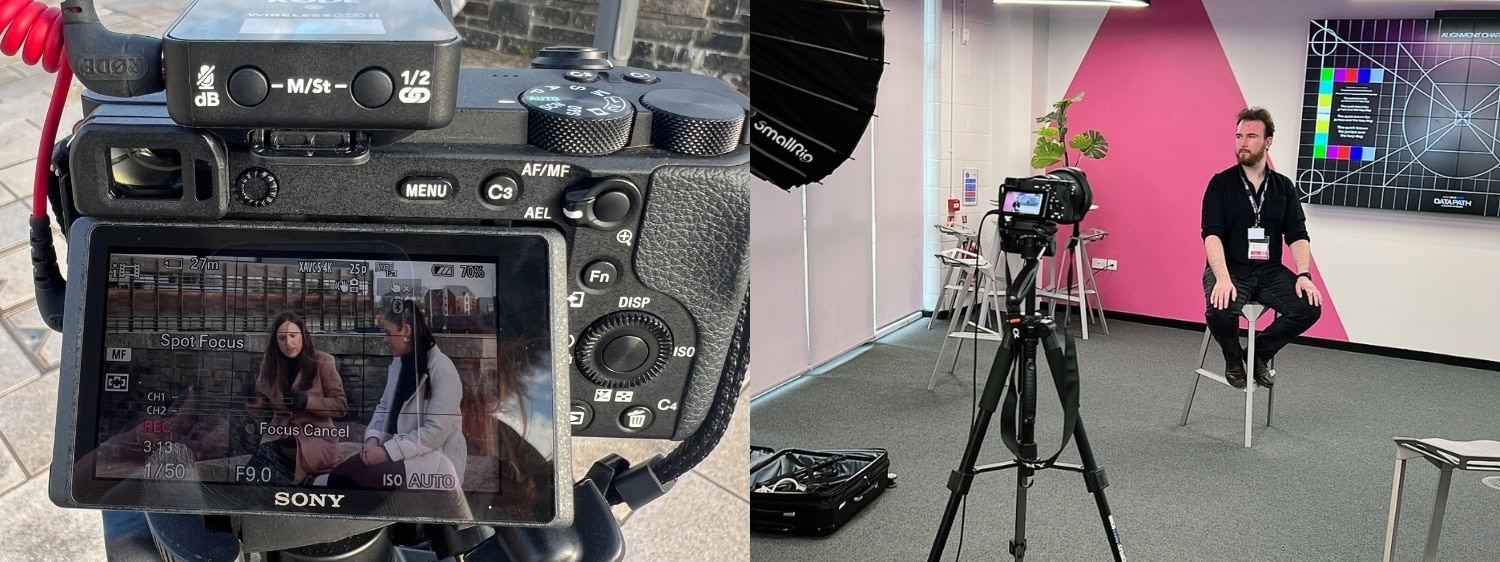
This is where all our planning comes to life. Effective pre-production avoids surprises such as unexpected stairs to lug heavy kit up, huge echoey acoustics, hosts wearing the same colour outfit as the background or a lack of plugs for lighting.
Even if the script is more of a loose plan, it’s essential to be prepared. Our clients are mostly leaders of companies or technical specialists, not actors who are used to being on camera, so knowing what they’re being asked, what the purpose of the video is and who their audience is ensures it’s valuable.
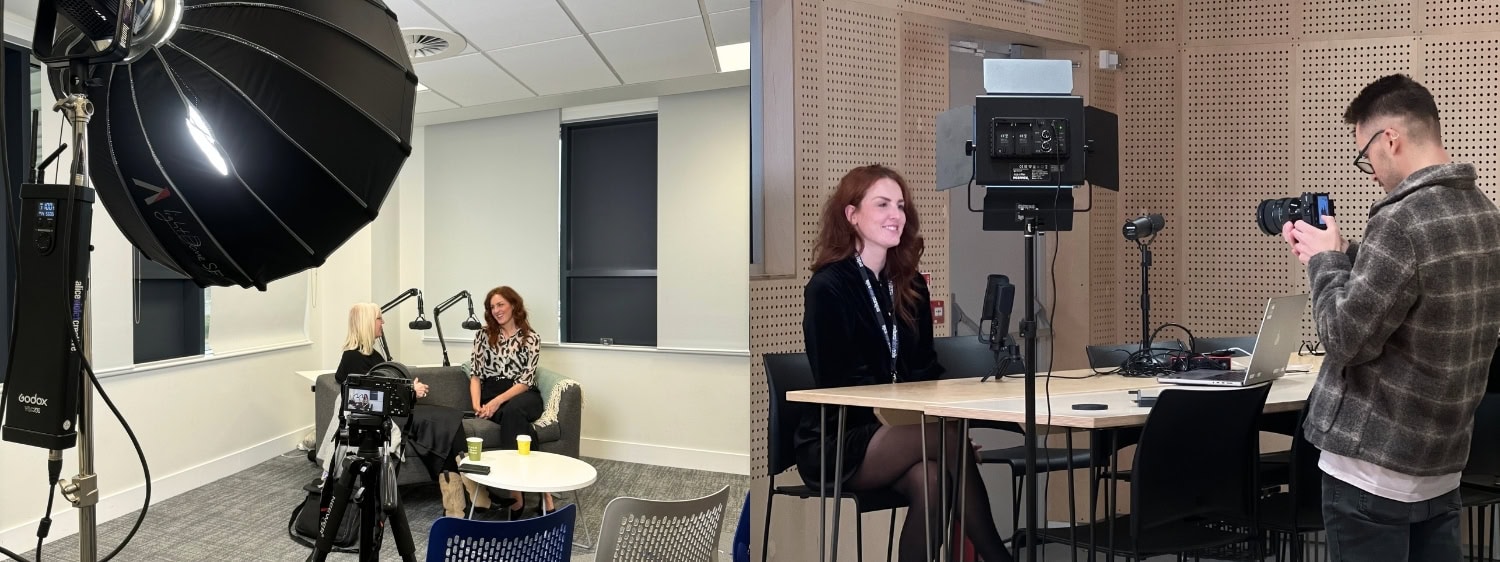
Production is much more technical than the strategic and logistical parts of pre-production. Here are the key considerations:
- Lighting
- Sound – are we using boom mics, wireless lapel mics or podcast mics? Do we need to manage the acoustics of the surroundings such as a festival tent or cathedral?
- Key shots: Is this an event with a key speaker? Is the context of the wider location important?
- Framing shots
- Capturing B-roll footage – this is an essential ingredient for compelling storytelling.
Key Terms Used During Production Include:
Camera angles: Different positions from which the camera captures the subject.
Multicam: We capture the exact moment through multiple cameras so that we can later move between different viewpoints to add interest and hide cuts. This can also be achieved by shooting with a wide-angle lens; we can crop between close-up and wide angles.
Camera settings: Considering depth of field, lighting and more can make the same shot go from basic to cinematic.
Lighting: Utilising natural or artificial light to accentuate subjects and set the desired mood.
Sound: The process of recording clear audio using microphones, boom poles, and other equipment.
B-Roll Footage: Supplementary footage that provides context and enriches primary shots such as external shots of the venue, people talking or doing something relevant to the script.
Framing: The composition of a shot to include the appropriate balance of subject and background.
Post Production
Once all essential footage is captured, the focus shifts to post-production. This phase takes all the elements to craft a refined and captivating video. It involves organising your footage, selecting the best clips, and arranging them in a cohesive and visually appealing way.
Key Terms During Post-Production Include:
- Colour correction
- Creative visuals
- Audio levelling
- Synchronising audio and video clips
- Music
- Graphics
- Animation
- Special effects
- Transitions
- Stock Footage
- Text
Editing: Selecting and assembling shots to form a coherent sequence.
Colour Grading: The adjustment of colours in a video to enhance its visual tone and style.
Transitions: Visual effects that facilitate the smooth transition between shots.
Special Effects (VFX): Computer-generated effects used to enhance or create elements within the video.
Animation: Adding visual effects using graphics, text and transitions.
Sound Editing: The refinement of audio tracks by adjusting levels, adding effects, and synchronising with the visuals.
Subtitles and Captions: Text displayed on screen to convey spoken words or essential information.
Stock: Like audio, pre-recorded video content that can be licensed and used in various film and video projects to enhance or complement the original footage.
How to Work With Us: Video Production and Editing Services
By familiarising yourself with video production and editing terminology, you’ll gain a better understanding of the process, empowering you to collaborate more effectively with agencies like ours to create professional content.
Contact us with your needs and we’ll get in touch to arrange an intro call with the team.

TILLY
I manage the social media strategies of AVC and our key clients. This involves content planning, creative campaigns and daily management. I am the team expert for all things social media, such as algorithm and platform updates, and how to formulate compelling social-first content. I also am a content specialist who loves writing and video editing.
SPECIALISMS
+. Social Media Strategy
+. Social Media Management
+. Digital Marketing Strategy
+. Content Strategy
+. Content planning
+. Writing
+. Video editing