
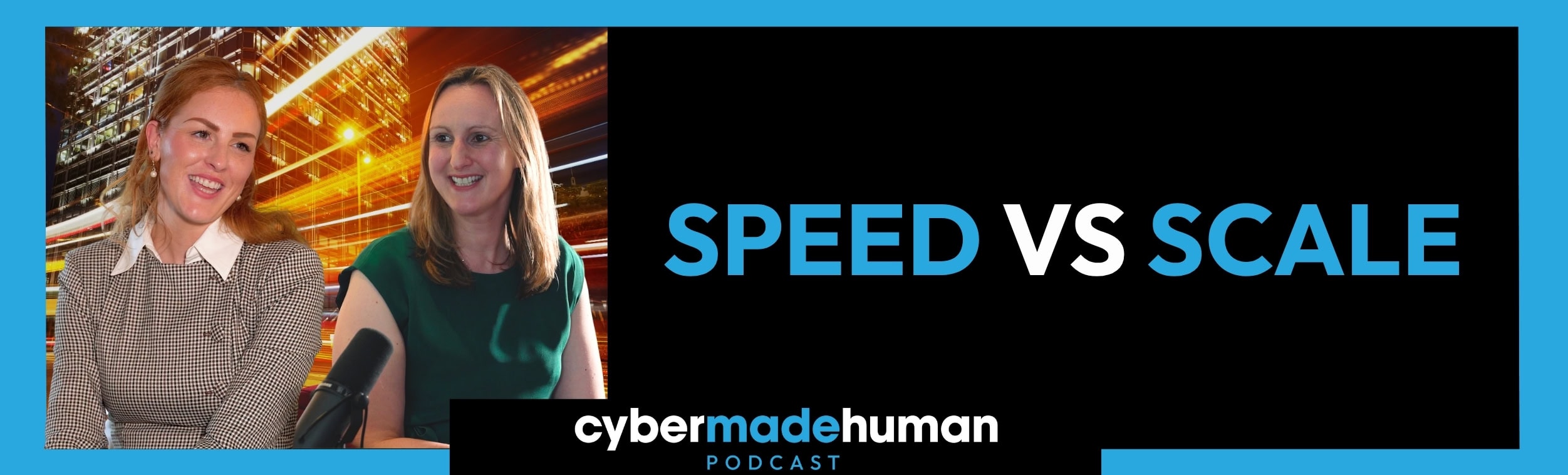
Startup Speed vs Government Scale
In this episode of Cyber Made Human, we sat down with Rebekka Bishop to discuss the pros and cons of scaling startup speed for government innovation and the complex barriers imposed.
You can watch the full episode on our YouTube and Spotify pages. Check out the full episode transcript below to learn all about this topic and our discussion on it.
Disclaimer: This transcript is an outline of the dialogue exchanged in this episode and may therefore contain inconsistencies with the video version.
Our book recommendations for this episode were:
Alice: The Book You Wish Your Parents Had Read by Philippa Perry
Rebekka Bishop: Why Has Nobody Told Me This Before? by Dr. Julie Smith
To discover more book recommendations, check out the Cyber Made Human Bookshelf

Start-up speed VS Government Transcript
Alice: In this episode, I’m joined by the wonderful Rebecca Bishop, who is a former inventor turned startup founder and a highly requested guest to have on Cyber Made Human. So we’re delighted to have her. This episode was filmed at the series two launch party that we held here in Cheltenham a few weeks ago. So we do have a live audience present, and it’s a slightly different format to usual. We discuss the differences, limitations, challenges, and opportunities between startup speed and government scale. Let’s get started.
So when I ask people for recommendations of who to have on the show, your name came up a lot, so I’m so pleased that we could have you for the launch event. It’s really, really good. So thank you for being here.
Rebekka: Thank you. No, it’s lovely.
Alice: And we know each other then from Grown in Cheltenham, which is a bit of a business accelerator program that both of our businesses are on. But for anyone in the audience and watching who doesn’t know you, can you tell me a bit about your background and what you do now?
Rebekka: Right. Well, I’m the Director at Zest Intelligence. It’s a newly formed startup. We do professional services for the UK government in the highly regulated sector.
So my background, gosh, um, I’ve done lots of things. I went to Brunel University and did industrial design and technology when there was only one degree in computer science and things. Then I won the BBC’s best inventions, back in 2002, with my smart plant pot invention, which threw me into the limelight.
And as a result of that, um, I met royalty and got onto a campaign, really, of supporting women in STEM. So I’d done that for 12, for 20-odd years. Hence, all the things that I’ve done previously and had children in the meantime. I think after I was in the defence sector, I was in the pharmaceutical sector for a while.
And then I came to a point where I was a returning mother after my second child. Uh, and that’s when I came across really what was going on within Gloucestershire at the time. There was a huge sort of growth in the cyber market and what was happening here. And I’d basically pivoted, used my skill sets and transitioned into the cyber sector.
And at the same time, because I found there was no network, it was a very little network. And this is when I came across CyNam ’cause they too were setting up. I set up Gloucestershire STEM Network, which is for women in underrepresented groups, so that was sponsored by the GFirst LEP at the time, and then later by the University of Gloucestershire.
I’ve done a lot of things promoting engineering, uh, especially for women and for young girls, and also being a returning mom, and you know, championing that campaign as well. So yeah, lots of things are going on, but my next adventure is zest intelligence. I run it with three other founding directors as well, and I think it’s taking that leap of faith. And saying You’ve gotta do these things. Yeah. And saying, I’ve got the skill sets, let’s go for it.
Alice: Great. So I think it’s really good to understand your background, ’cause I know you’re from Zest Intelligence, but even understanding that you were an innovator and you won awards for that, you know, a long time ago and you’ve worked for government, I think these are things that you wouldn’t necessarily talk about now and so it’s really great to bring that background into this conversation.
Rebekka: Absolutely. For many, many, many years never told anyone. What happened, fact all those years ago when I was 22, I mean, I was a young female inventor and not a lot of people like that. To be truthful.
It was a time, and still very challenging. And I was part of that movement to bring about change. I was talking to someone else, they said, You’ve got to start sharing this story because it’s still very relevant. But to me it’s a toolbox. You know, it’s one of those things in my life’s a toolbox that comes out, you know, innovation is
The heart of me. In everything I do that applies within cyber and digital, you know, it’s still there. I know everyone thinks you can’t see it, but it’s out there, and it is still. You’ve got to think more innovatively. So it’s been the foundation of my life and, you know, one day my children will work and find out that their mom did all these great things, and my giving back was very much about supporting women and, obviously, young people to get into STEM careers. And that’s when I was also asked to run the Cyber First, Gloucestershire, the region, which now CyNam actually runs the Southwest area for that.
So I was part of that story with Madeline. Done, done a lot of things. Yeah, it’s the heart of and part of me.
Alice: Amazing. And I think we’re really lucky in Cheltenham, and that’s one of the reasons I wanted to start Cyber Made Human, there are so many amazing communities doing such innovative work. You know, we’ve got CyNam as an example, but there’s just, that’s probably the best example, but there are lots of groups of people making amazing innovations and change and collaborating together, and you are definitely an example of that.
So it’s really good to understand your background, and I think. What we are here to talk about today with you is the kind of government scale versus startup speed and the fact that you’ve got a background in both of those areas. The conversation that we just had with Cath was about how to communicate with different audiences.
It’d be interesting to hear your experience as someone who used to work there. In government and now in the startup space. What kind of insights are you having on that?
Rebekka: So compliance and regulation are key to all businesses now, you know, and, um, you know, companies don’t think they’re immune to that. They are cause everything is digital nowadays. Yeah. And I think, you know, all startups struggle with that compliance aspect. We were touching on it just earlier, and it can seem quite boring as such, but it is fundamentally key for you to trust your customers, and a lot of frameworks and these organisations, you need to meet those requirements.
So, for example, Cyber Essentials and Cyber Essentials Plus are essential to all businesses now, and a lot of our customers and frameworks are, you know, that is almost a prerequisite. You know, there’s, um. Lots of things around, support as well—code of conduct, code of governance and things, um, to help organisations.
There are the ISO standards, GDPR, and data protection, which we were talking about with Cath as well. There’s almost like. There’s an entry criteria. When you’ve got that idea on a piece of paper, you’ve got to consider compliance. It, it can’t be, you can’t, can’t miss it.
It is part of the core foundation of your business. And that’s really fundamental. And it is challenging because when you’re looking at it for the first time. It can be very, very daunting, but equally, and I think this is one of the benefits it has, it provides those sets of requirements that you can walk through.
And you have to be a jack of all trades when you’re a startup, you know? And sometimes it’s just asking the right question or knowing who to go to, to ask those questions as well, um, to walk through that process. And you have a limited amount of funding. To do it. So a lot of it you’re doing yourself, and it’s very resource-constrained as well, but once you do meet those requirements, you effectively, you’ve met them, and you are in there.
And it can take, can take many months, you know?. It can, it can take a long time. We are actually at the end process of a number of frameworks at the moment, and they keep asking for more and more things all the time. So, with a startup, the advantage is the fact that. We’ve got the agility and the creativity in that space, but compliance can.
Slow it down. And you have to weigh it up. I mean, there’s some days where I think, gosh, I haven’t done anything fun, you know as such, or, you know, where Helen and i are dealing, you know, dealing with the fundamentals of the business and I. It can get quite down sometimes, but you’ve got to keep motivating yourself and that resilience to go forward.
It is relevant and it’s a cornerstone of the organisation and it’s key, ’cause if we don’t do it, we don’t have a business effectively. And as long as you’ve done all the essential, um. Requirements and regulatory and security checks, et cetera, then you are going to be okay. But it’s something you have to continually assess.
You can’t, you know? You can’t just say, I’ve done that. I’ll come back to it next year.
Alice: And that’s because you are selling just to the government. Where, if you were selling commercially. You wouldn’t necessarily have to jump through those hoops. And would you say that actually it makes your business stronger by having to jump through those hoops as painful as they are, because even as a marketing agency, we do work via third parties for councils, for example, because we literally don’t have the capacity to be going through the Legislation and procurement processes. But would you say that it does make you in a stronger position for any market?
Rebekka: It does, and it’s a high barrier to entry. Yeah. I, I’m not, you know, that is definitely it. It’s very, it’s not for everyone, and it’s incredibly challenging, and you have to sort of know what those.
Pitfalls are going to be, and what you, what, you know, what you need those requirements to meet, but you are absolutely, obviously right. If you go through a third party, they will reduce that risk; however, they will expect that through their supply chain, you’ve met certain standards. Working with that, with that customer and its, it’s all about risk management to them around data management and also, you know, to yourselves. So every customer, every framework. They might have slightly different variations of requirements, but normally, they’re typically, if you’ve done one, you’ve done the hard work.
Advert: This episode is sponsored by CyNam. CyNam is a thriving community of investors, academia, government, and industry. Also, anybody interested in emerging technology and cybersecurity. I’ve been a member of CyNam for over two years, and I’m now also an ambassador and a mentor for emerging creatives on their platform.
Alice Violet Creative is also proudly CyNam creative partner, having just wrapped up a six-part documentary series with their team. CyNam events are free and open to all, so do come along and get involved. If you’re interested in joining the community, you can find out more at CYNAM.org. Thank you for sponsoring this episode.
The Cyber Made Human Podcast is produced by Alice Violet Creative, my content marketing agency based in Cheltenham, we specialize in complex brands, which primarily means those in emerging technologies, cybersecurity and intelligence, we’re able to take abstract, clinical and difficult topics and make beautiful, compelling and results driven content.
So get in touch with us for digital marketing and all your content needs.
Alice: Yeah. And would you say then that some of the, in any industry. Companies that governments are working with are actually, they’ve got a limited pool to look at. And so there might be some incredible startup that they can’t even consider because they haven’t got the capacity to go through it.
And is there an opportunity there? To actually for them to notice them and help them through the process? And does that exist, that infrastructure so they can actually see them if they’re not ready to work with them?
Rebekka: Yeah. Yeah. Um, absolutely. And, uh, so you’ve got products where your professional services, I know, like the NCST for startups, they, they do handhold you through some of those processes.
Through professional services. The larger frameworks or primes, as they call them. Can will handhold through that process. Yeah. Um, but also they expect that you will meet those requirements. Yeah. To some degree. And like our security management plan that we’ve now just completed, um, that was quite a long, lengthy process to make sure we’ve met all those requirements, but now we’ve got it.
We are compliant. And it’s, you know, it’s a great testament to the team that, um, we’ve done that. So it’s fundamental to the business. Um, whereas Catherine was talking about. Compliance and cybersecurity being. You know, people recognising it as not nice to have, but, you know, but recognising it’s important.
It’s fundamental to our business. We can’t get around it in any other way. We have, we do that or we’re not in business at all. So it is, it’s challenging.
Alice: What would you say the key benefits are about being in a startup? What do you have the freedom to do, if any that you didn’t have? When you’re working, In house of government?
Rebekka: Yeah. So with being a startup, obviously you’ve got that agility, you work agile, um, you can fail fast and learn. I describe it as a startup being a speedboat. And we’re building this big speedboat. Um, we’ve got all our life jackets on there, which is the compliance, um, you know, that safety net, uh, that we’ve had to.
Build ourselves. It hasn’t magically happened. And then the government is this larger tanker. You know, to bring about change. It takes longer to navigate. Uh, whereas we can move and pivot much quicker and, and respond better. And, and also at scale, uh, so we can scale up quite quickly or scale down.
And government obviously, um, where Cath was talking about the approval process and, and the, uh, going to the CEO and, and getting that, uh, approval sponsorship, to take something forward, you wouldn’t necessarily have to, to do that. As such, you can make those decisions on the fly. And we make decisions in the morning and
We’ve done it in the afternoon. Yeah. You know, so I think that’s the most exciting thing, and for me, being an innovator, going right full circle is the fact that, um, I love that the first time I can be that innovator as I was. When I was younger, but obviously I’ve got just a grown-up pair of shoulders now, and I have to think, well, I have got legal requirements and ethical, um, you know, ethical boundaries and things I have to consider and staff as well.
So it’s, um, it’s taking all that experience and having that mindset of creativity and bringing it to life in, um, in a way that before was very stagnant and slow. However, I’m not going to say anything negative. Too many negatives, ’cause you can bring agile ways of working into government. Yeah. And you can do it. Um, and they do do that.
So they do fail fast, through discovery phases. But still, the process to get approval of funds is very slow. So from a delivery perspective, it still can happen, but it’s more regimented, if that makes sense.
Alice: And when you say this. Discovery process. And that’s really interesting because if they’ve got kind of threads of projects that they know could fail.
Yes. As a government having that money and project, and saying we’re okay if that fails. Exactly. Which is kind of how a startup operates. That’s a very different mindset to what I would’ve imagined existed there, where everything has to be, you know, worthwhile.
Rebekka: Yes. So the, the authority does work like that.
The government does work like that. Okay. Interesting. And, they are looking at, you know, startups and an industry and taking those lessons learned because they need to innovate. They need to also be, um. Ahead of working in parallel with. New technologies and things or keeping up to date.
So they too recognise that. And, I think that’s where you get that collaboration that has to happen, really, between both government and startups. And I’d like to see more, to be honest. And uh, you know, CyNam and Plexal, they do a lot of work with that. Um. And learning from each other. Because in my, you know, from what we’ve been through around compliance, I would love someone to have walked us through.
That, and recognising there’s going to be gaps in our knowledge and gaps of where we are. But, but equally, we’ve got that agility and going, wait, there’s an opportunity here. We can solve that problem for you. We can do, you know. Minimal viable product or prototype or proof of concept, um, very quickly.
So it’s a collaboration of the two worlds? I think so, and yeah. Have a super speed tanker. I’m not too sure what that looked like, but,
Alice: Yes. Well, I was gonna say, having gone through the process the hard way there, and you’ve had to learn it all yourself and allocate the time and kind of pause innovation while you do it.
For anyone who’s thinking about going into that process, what’s the advice you’d give them?
Rebekka: Oh my goodness. Oh, I would probably say go for it. Okay. Um, be resilient and go for it. I, you are not gonna know everything, ask lots and lots of questions, don’t be afraid to not know everything.
And, just ask for help and we, you know, I’ve been very fortunate. I’ve got three other directors who are amazing and we’ve all got our different strengths and we complement each other very well. And I’m very, I feel very, very fortunate. I think you have faith in yourself and be, and it’s, it’s all.
Being you, isn’t it? And one of the, I remember doing a pitch to one company and I actually said to them, I dunno what they thought afterwards about me, but I said, I just wanna be me. I’ve had all these years of not being me. I just want to be that innovator.
And, you know, and I, that’s what it’s about. It’s about having that freedom. But also recognise you have those responsibilities and compliance and every, you know, all the things that come together, but you know how that all works.So, yeah. So I still dunno how that went afterwards, but we did actually win work, so that’s good.
Alice: Now you’ve gone through all this compliance, you’ve done it, you’ve done the hard slog, and it might be a long-term thing in terms of keeping it all up, but what’s next? Now that you’ve done that?
Rebekka: Oh goodness. Well, it’s growth, isn’t it? That’s another challenge.
Alice: Okay. It’s so, it’s scale time.
Rebekka: Scale time. Yes again. I am not, you know, I’m not sitting there going, I’ve done it all now. I, it, it scares me. It’s, I know it’s that massive big step forward for us all. Um, we’ve got a really good foundation of the business. Um, and I’m very proud of everyone.
We’ve got our infrastructure effectively. Uh, yeah, it’s growth. It’s recruiting people. So we have our next new starter starting in June,
Alice: Really amazing. What’s the new role?
Rebekka: It’s just another consultancy role. Yeah. So it’s another staff member.
Alice: Well, my final question for you is for the Cyber Made Human bookshelf, right? We always ask our guests to recommend a book. It doesn’t have to be relevant to what we’ve just talked about, but it can be, just a way of us getting to know you a bit better. So what could recommend for
Rebekka: I do a lot of reading around mental health and resilience as well, which I’m hoping that it came out about how important resilience is. So the book is called Why Nobody Told Me This Before by Dr Julie Smith. It’s really, really easy to read. It’s got a lot of life’s toolkits in there. I wish someone had given that to me. I also asked, and said to my mum, you should read it as well.
Definitely a good one. Any point of your life in there, um, you know, it touches on and I’m also currently reading. Becoming from Michelle Obama as well, which I’m finding very inspirational.
Alice: Amazing. I can see that you’ve got lots of little notes in there. Is there one quote that stood out to you?
Rebekka: Oh, goodness me. Okay. This might be a good one. Uh, getting clarity on our personal values can guide us on setting goals that will bring meaning and purpose.
Alice: That’s very true. Yeah, definitely.
Rebekka: So there you go.
Alice: Thank you. Well, my recommendation for this episode is the book I wish my parents had read by Philippa Perry.
And it’s exactly what it sounds like. It gives you a really good insight into your own parents and seeing them as a 360 human being who has the same flaws and dreams and desires as you do, who’s also a parent, but also it gives you a very different insight on how to interact with other human beings.
And, just another kind of in a similar category, easy read that’s got some interesting insight. But thank you so much for joining me today. I really enjoyed that episode, and I hope you guys did too. Thank you. Thank you
Watch the episode now!
Watch on Spotify
Watch on YouTube
GET IN TOUCH FOR ALL YOUR 2025 EVENT NEEDS
PHOTOGRAPHY | VIDEO | LIVE STREAMS | LIVE PODCASTING | SHOW REELS